
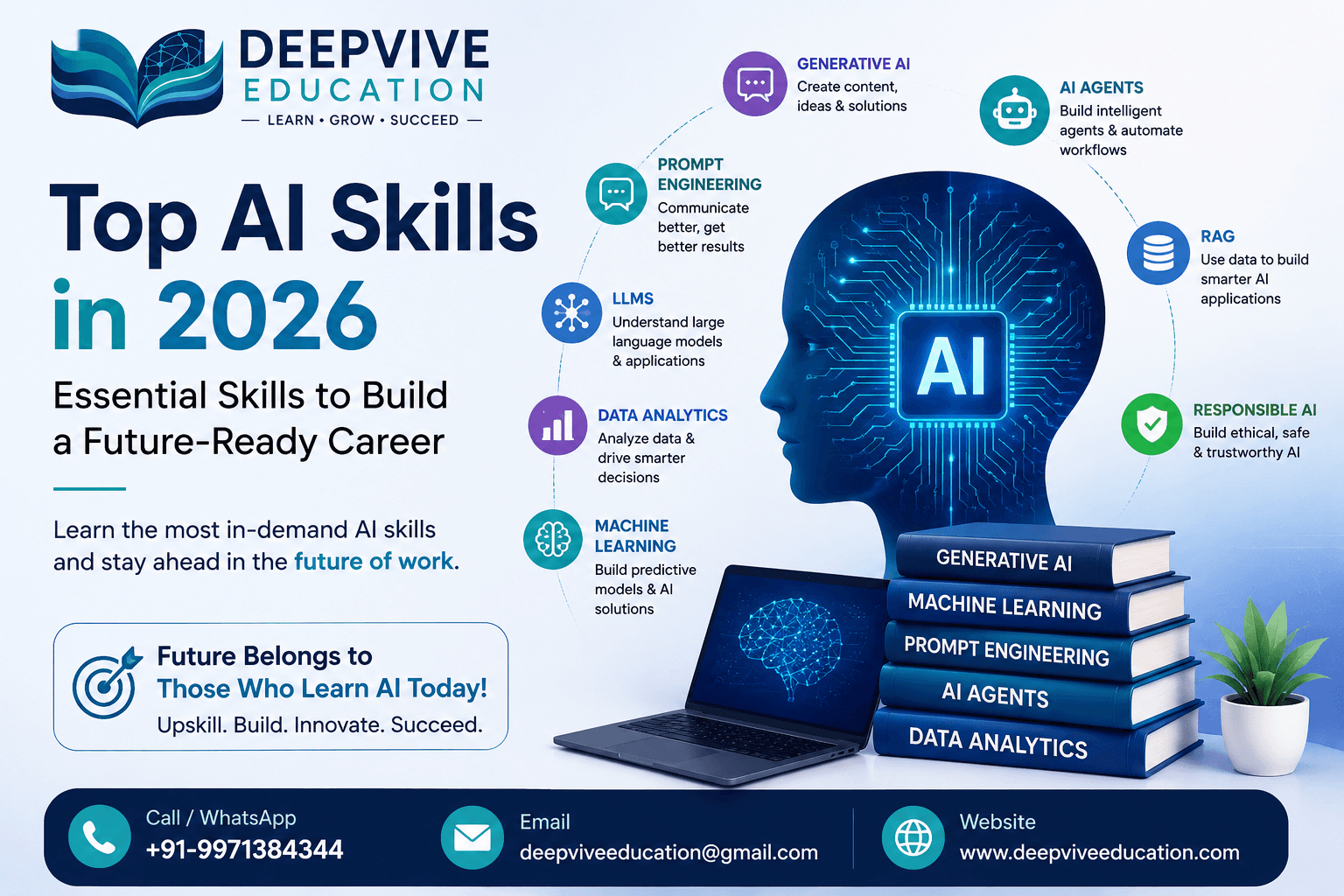
Top AI Skills in 2026: What Should You Learn?
Artificial Intelligence is rapidly changing how businesses work, how professionals solve problems, and how new careers are created. In 2026, learning AI is no longer limited to becoming a machine learning engineer. Professionals across marketing, finance, education, software development, healthcare, operations, and business are increasingly expected to understand and work with AI.
According to the World Economic Forum's Future of Jobs Report 2025, AI and big data are among the fastest-growing skills, while technological literacy, analytical thinking, creative thinking, and lifelong learning are also expected to become increasingly important. The report also estimates that 39% of workers' existing skill sets could be transformed or become outdated between 2025 and 2030.
So, what are the top AI skills in 2026 that students, professionals, and aspiring AI specialists should focus on?
Let's explore them.
1. Generative AI
Generative AI is one of the most important AI skills to learn in 2026.
Generative AI systems can create text, images, code, presentations, summaries, ideas, and other forms of content. Tools powered by large language models are increasingly being integrated into everyday professional workflows.
Learning Generative AI means understanding more than simply using an AI chatbot. You should learn:
- How Generative AI works
- Large Language Models (LLMs)
- AI-assisted content creation
- AI workflows
- AI productivity tools
- Model limitations and hallucinations
- Practical business applications
For beginners, Generative AI is an excellent starting point because it introduces AI concepts through practical applications.
2. Prompt Engineering
As AI systems become more capable, the ability to communicate effectively with them remains valuable.
Prompt engineering involves designing clear and structured instructions that help AI models produce useful and reliable results.
A good prompt can include:
- Context
- Role
- Objective
- Instructions
- Examples
- Constraints
- Desired output format
However, prompt engineering should not be viewed as simply learning a collection of prompts. Professionals should understand how to evaluate AI responses, refine instructions, provide appropriate context, and combine AI with their existing domain knowledge.
The World Economic Forum has highlighted prompting, trust, training, and human skills as part of the capabilities needed as organizations increasingly work with AI agents.
3. AI Agents and Agentic AI
One of the major developments shaping AI in 2026 is Agentic AI.
Traditional AI applications often respond to individual instructions. AI agents can go further by planning tasks, using tools, processing information, and taking actions toward a defined objective.
Learning AI agents can involve concepts such as:
- Agent architectures
- Tool use
- Workflow automation
- Multi-step reasoning
- Agent orchestration
- APIs and integrations
- Human-in-the-loop systems
- AI agent evaluation
As organizations move from AI assistants toward more autonomous systems, understanding how to design, supervise, and evaluate AI agents can become an important career skill. The World Economic Forum notes that agentic AI introduces new requirements around visibility, governance, security, and the ability to audit or override decisions.
4. Machine Learning Fundamentals
Even if your goal is to work primarily with Generative AI, machine learning fundamentals provide a strong technical foundation.
You should understand concepts such as:
- Supervised learning
- Unsupervised learning
- Classification
- Regression
- Clustering
- Model training
- Model evaluation
- Overfitting and underfitting
- Feature engineering
You don't necessarily need advanced mathematics to begin learning machine learning. A practical understanding of how models learn from data can help you understand modern AI technologies more effectively.
5. Large Language Models (LLMs)
Large Language Models are at the center of today's Generative AI ecosystem.
Understanding LLMs can help learners move from simply using AI to understanding how AI applications are built.
Important concepts include:
- Tokens and embeddings
- Transformer architecture
- Context windows
- Inference
- Fine-tuning
- Model evaluation
- LLM APIs
- Open-source versus proprietary models
This knowledge can be particularly useful for developers, AI engineers, product professionals, and entrepreneurs building AI-powered applications.
6. Retrieval-Augmented Generation (RAG)
Retrieval-Augmented Generation (RAG) has become an important technique for building AI applications that can work with private or specialized information.
Instead of relying only on information learned during model training, RAG systems can retrieve relevant information from external knowledge sources and provide that context to an AI model.
Learning RAG can include:
- Document processing
- Chunking
- Embeddings
- Vector databases
- Semantic search
- Retrieval pipelines
- Context management
- RAG evaluation
RAG is especially useful for applications such as knowledge assistants, document search, customer support, internal company systems, and educational tools.
7. AI and Data Analytics
AI becomes significantly more useful when combined with strong data skills.
Professionals should learn how to collect, clean, analyze, visualize, and interpret data. AI can accelerate many of these activities, but humans still need to understand the data and evaluate whether the conclusions make sense.
Useful skills include:
- Python
- SQL
- Data cleaning
- Data visualization
- Statistics
- Exploratory data analysis
- AI-assisted analytics
- Business intelligence
The World Economic Forum identifies AI and big data as the fastest-growing skill category in its 2025–2030 outlook.
8. Responsible AI and AI Ethics
Technical skills alone are not enough.
As organizations use AI for increasingly important decisions, professionals need to understand responsible AI.
Important areas include:
- AI bias
- Privacy
- Data security
- Transparency
- Explainability
- Model evaluation
- Human oversight
- Responsible deployment
- AI governance
AI professionals need to know not only “Can we build it?” but also “Should we build it?” and “How can we deploy it responsibly?”
Human oversight remains important because AI systems can produce incorrect or misleading outputs and may not understand the real-world consequences of their recommendations.
9. AI Automation
Another valuable skill in 2026 is the ability to identify repetitive business processes and use AI to improve them.
AI automation can be applied to:
- Customer support
- Marketing
- Lead management
- Content workflows
- Data processing
- Reporting
- Research
- Administrative tasks
Professionals who can combine AI tools, APIs, automation platforms, and business processes can create significant productivity improvements.
The key is not simply automating everything. It is learning where AI adds value and where human involvement is necessary.
10. Human Skills That Work With AI
Perhaps the most overlooked AI skill is the ability to work effectively with AI.
AI knowledge should be combined with:
- Analytical thinking
- Critical thinking
- Creative thinking
- Communication
- Problem-solving
- Adaptability
- Collaboration
- Continuous learning
The World Economic Forum ranks analytical thinking as the leading core skill identified by employers, while resilience, flexibility, creative thinking, curiosity, and lifelong learning are also highly important.
This means the future is not simply about AI skills versus human skills. The strongest professionals will combine both.
How to Start Learning AI Skills in 2026
If you're a beginner, don't try to learn everything at once.
A practical roadmap is:
Step 1: Learn AI and machine learning fundamentals
Step 2: Learn Generative AI
Step 3: Practice prompt engineering
Step 4: Explore LLMs and AI tools
Step 5: Learn RAG and AI agents
Step 6: Develop Python and data skills
Step 7: Build real-world AI projects
Step 8: Learn responsible AI and evaluation
Step 9: Create a portfolio
Step 10: Continue learning as AI evolves
The most important thing is consistency. AI technology changes quickly, so learning how to learn and adapt is itself a valuable skill. The World Economic Forum describes these broader “meta-skills”—including higher-order thinking, experimentation, and adaptability—as increasingly important in a workplace where skills can change rapidly.
Final Thoughts
The top AI skills in 2026 go far beyond learning how to use a chatbot. Generative AI, prompt engineering, AI agents, LLMs, RAG, machine learning, data analytics, AI automation, responsible AI, and human-centered skills are becoming important parts of the modern AI skill set.
You don't need to master everything immediately.
Start with the fundamentals, choose a practical learning path, build projects, and continuously upgrade your knowledge.
At Deepvive Education, our goal is to help students and professionals develop practical, career-oriented AI skills through structured learning and hands-on education.
Learn AI. Build with AI. Prepare for the future.
🌐 Website: www.deepviveeducation.com
📧 Email: deepviveeducation@gmail.com
📞 Call/WhatsApp: +91-9971384344